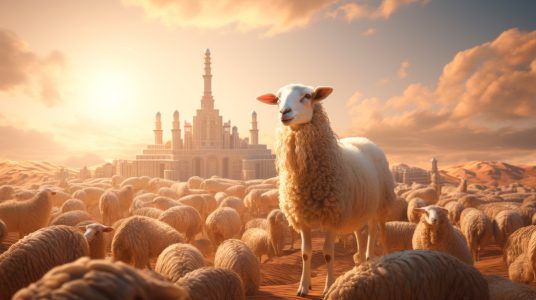
Every year, millions of Muslims around the world perform qurbani — the sacrifice of an animal on the days of Eid-ul-Adha. Knives are sharpened, animals are selected, and the act is performed with varying degrees of understanding about what it actually means.
For many of us, qurbani has become a cultural ritual — something we do because our families always did it, because it is part of Eid, because the meat is shared with neighbours and the poor. All of this is good. But if we stop there, we miss the heart of what Allah actually wants from this act.
The Story Behind the Sacrifice
To understand qurbani, you must return to its origin — one of the most powerful stories in the Quran.
Ibrahim (AS) had waited his entire life for a child. He had made dua for decades. And then, when he was very old, Allah granted him a son — Ismail (AS). A child he had longed for, prayed for, and loved with the depth that only a parent who has waited that long can understand.
And then Ibrahim (AS) had a dream. In the dream, he was slaughtering his son. The prophets' dreams are revelation, not ordinary sleep. He knew what this meant: Allah was asking him to give up the thing he loved most.
What happened next is one of the greatest moments of tawakkul in human history. Ibrahim told his son what he had seen. And Ismail (AS) — still a young man — said:
"O my father, do what you have been commanded. You will find me, if Allah wills, of the patient." — Surah As-Saffat (37:102)
Father and son walked together to the place of sacrifice. Ibrahim raised the knife. And at that moment, Allah called out:
"O Ibrahim, you have fulfilled the vision. Indeed, We thus reward the doers of good. Indeed, this was a clear trial. And We ransomed him with a great sacrifice." — Surah As-Saffat (37:104-107)
A ram was provided from Jannah. Ismail was spared. And this act of complete surrender to Allah became a ritual of sacrifice that Muslims would perform until the end of time.
What Allah Actually Wants
Allah makes something crystal clear in the Quran:
"Their meat will not reach Allah, nor will their blood, but what reaches Him is piety from you." — Surah Al-Hajj (22:37)
Allah does not need the animal. He does not benefit from the sacrifice. What He wants is your heart. The question qurbani asks you is: What are you willing to give up for Allah?
Ibrahim gave up his son — or was willing to. What do you give up? An animal. And even that symbolic sacrifice, done with full presence and sincerity, is accepted by Allah as an act of worship.
The Spiritual Preparation
The scholars say that before qurbani, we should reflect on what in our lives has become like "Ismail" for us — the thing we love most, the attachment that perhaps we have placed above our love for Allah. It could be wealth. Social status. A relationship. Our comfort. Our plans.
The act of qurbani is meant to symbolically remind us: everything I have is from Allah and belongs to Allah. I am willing to give it up if He asks me to. My attachment to the dunya does not surpass my attachment to my Lord.
The Practical Rules of Qurbani
Who Must Perform It?
Qurbani is wajib (obligatory according to the Hanafi school) upon every sane, adult Muslim who possesses the nisab (the minimum amount of wealth that makes zakat obligatory) and is not a traveller. For other schools, it is a confirmed sunnah.
When Is It Performed?
After the Eid prayer on the 10th of Dhul Hijjah, and continues until sunset on the 12th. The animal must be slaughtered after the Eid prayer — not before.
Which Animals Are Valid?
Goat or sheep (one per person), cow or buffalo (shared between up to seven people), camel (shared between up to seven people). The animals must be healthy, free of major defects, and above the minimum age.
The Distribution of Meat
The meat is traditionally divided into three equal parts: one third for the family, one third for relatives and friends, one third for the poor. This division ensures that the blessing of qurbani reaches beyond the immediate family.
For Those Who Intend Qurbani
From the 1st of Dhul Hijjah until the sacrifice is performed, do not cut your hair or clip your nails. This brings you into a state similar to the pilgrims in ihram — a physical reminder that you are participating in something sacred.
Making It Meaningful This Year
This Eid, before the sacrifice is performed, gather your family and tell them the story of Ibrahim and Ismail (AS). Remind yourselves why you are doing this. Ask everyone: what is your "Ismail"? What attachment in your heart needs to be placed back in Allah's hands?
Then perform the sacrifice — or attend it — with full awareness that this is not a cultural habit. It is an act of worship that connects you to Ibrahim (AS), to the prophets, to the first Eid-ul-Adha, and to the mercy of a God who accepted the intention of a father and spared the life of a son.
The knife cuts the animal. But the real sacrifice is in the heart.

Comments
Loading comments...
Leave a Comment